Relation of Plasma Physics to Ordinary Electromagnetics

Maxwell’s Equations

In vacuum:

In a medium:

Classical Treatment of Magnetic Materials

Time Varying E and B Field

Time-Varying E Field

The electric field
The polarization drift

The polarization drift

Time Varying B Field

The magnetic field
The magnetic moment is invariant in slowly varying magnetic fields
The magnetic flux through a Larmor orbit is constant
  • is constant if is constant.

Two-stage adiabatic compression of a plasma

The First Adiabatic Invariant,
The Second Adiabatic Invariant, J
The Third Adiabatic Invariant,

Nonuniform B and E Field

Nonuniform B Field

The guiding center drift velocity

The drift of a gyrating particle in a nonuniform magnetic field

Curved B: Curvature Drift

The centrifugal force
The curvature drift velocity
The total drift
: Magnetic Mirrors

Drift of a particle in a magnetic mirror field

The magnetic moment of the gyrating particle
The average force

A plasma trapped between magnetic mirrors

Nonuniform E Field

The electric field
The equation of motion

Drift of a gyrating particle in a nonuniform electric field

The finite-Larmor-radius effect

Uniform E and B Fields

The conditions: E = 0

The equation of motion
Cyclotron frequency

combine

The Larmor radius

we get

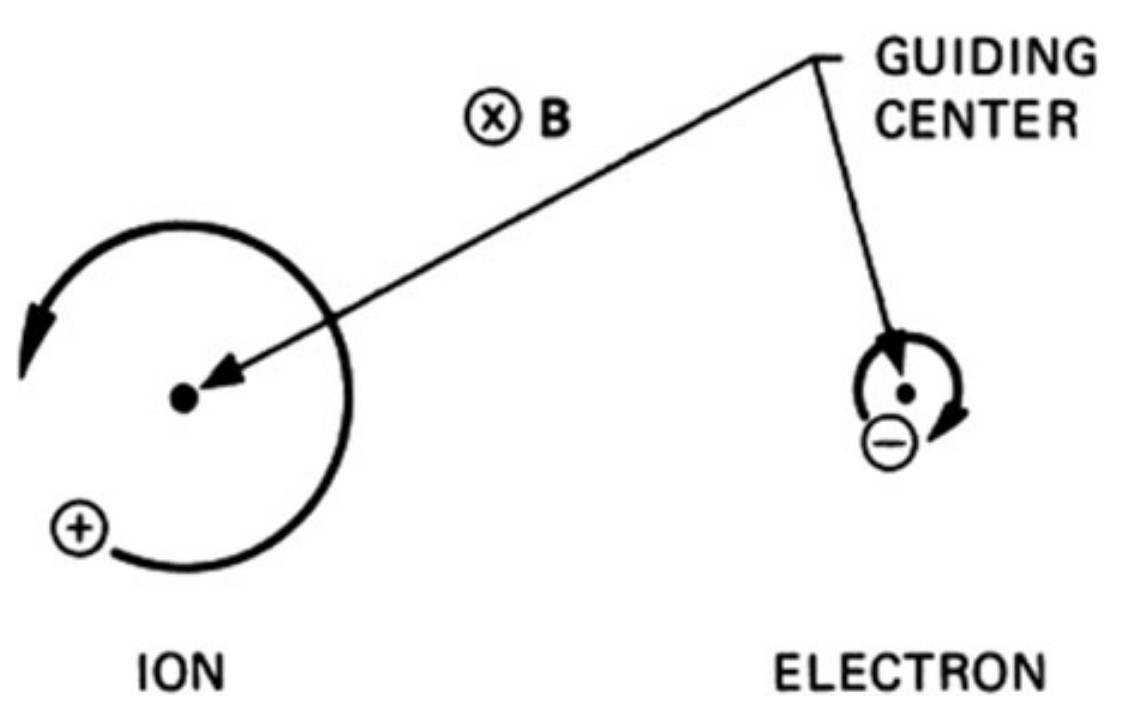
Larmor orbits in a magnetic field

  • guiding center ()
  • plasmas are diamagnetic

The conditions: finite E

The equation of motion

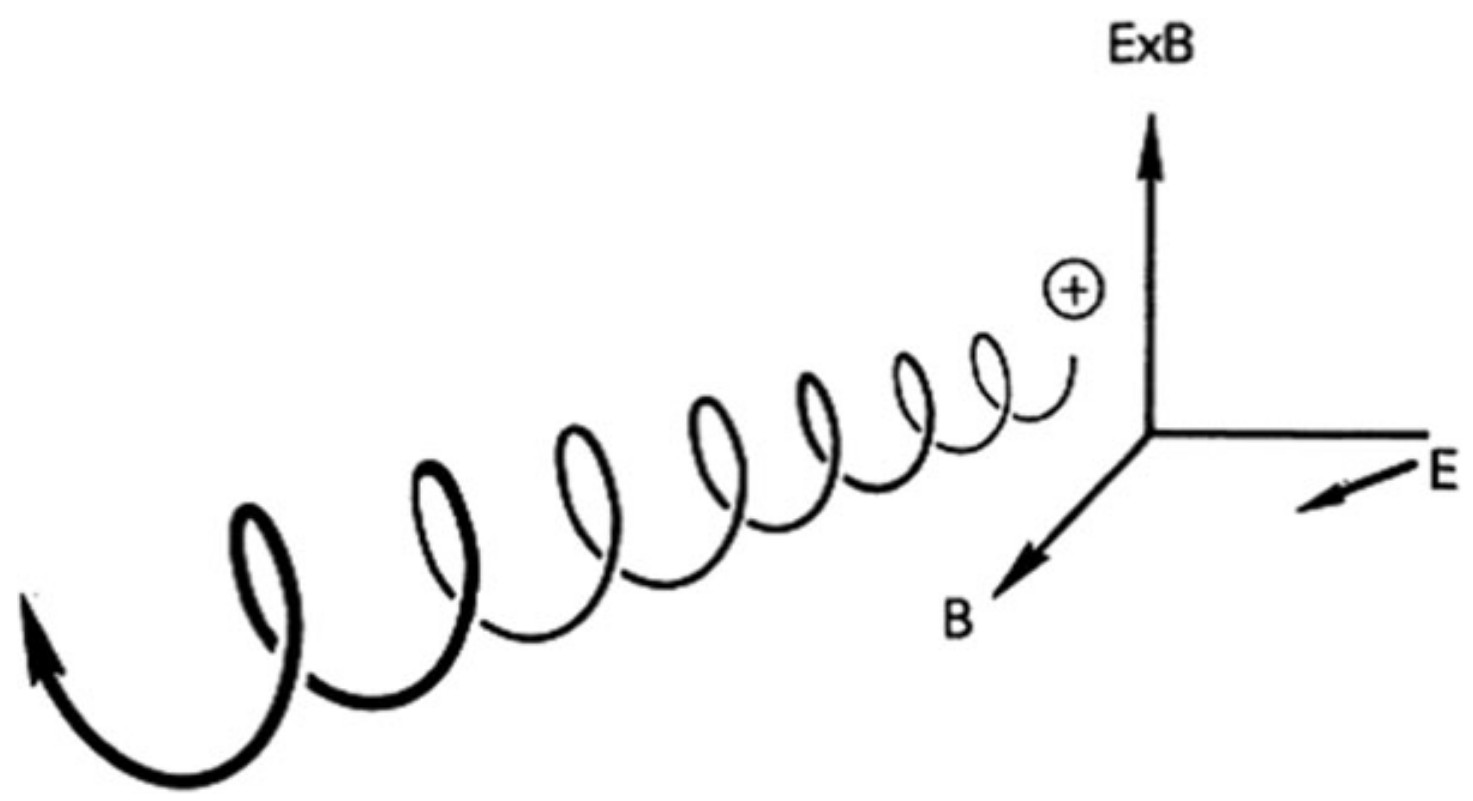
Particle drifts in crossed electric and magnetic fields

  • The usual circular Larmor gyration
  • A drift of the guiding center

The actual orbit of a gyrating particle in space

  • The three-dimensional orbit in space is therefore a slanted helix with changing pitch.

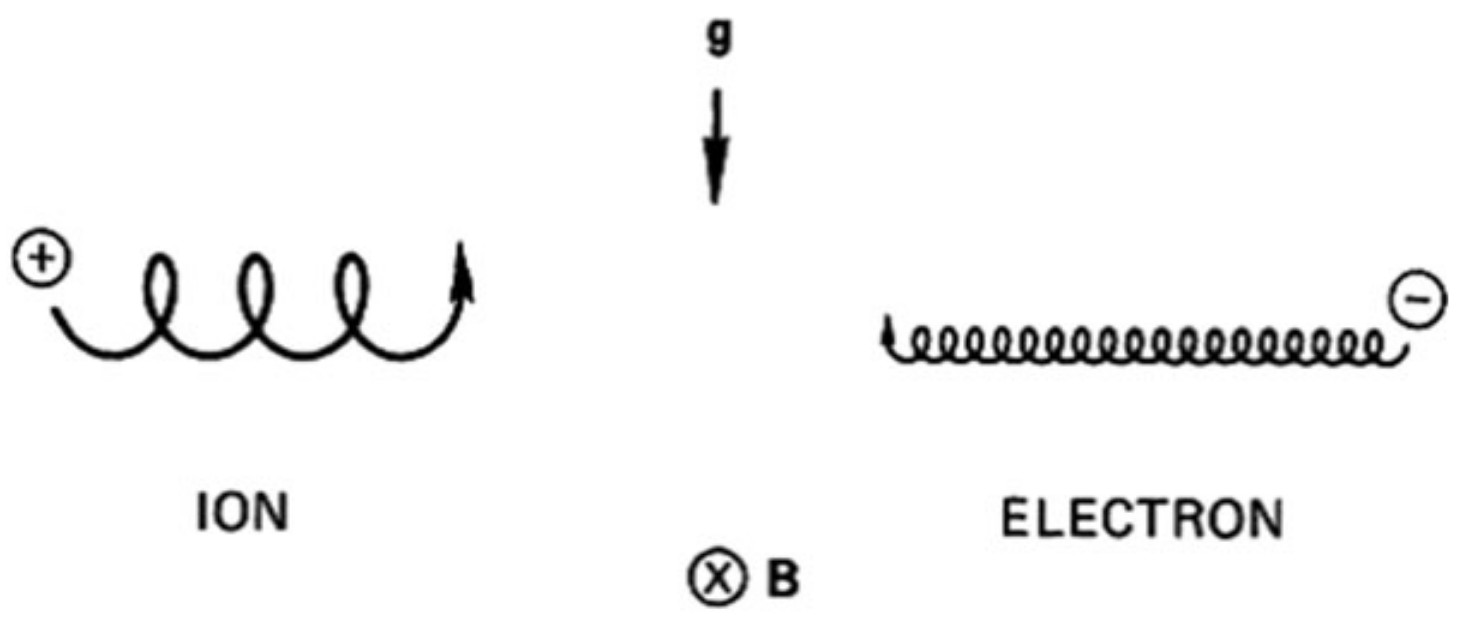
The conditions: gravitational field

The drift of a gyrating particle in a gravitational field

  • The magnitude of is usually negligible
  • But an effective gravitational force due to centrifugal force is not negligible

Reference Book
Introduction to Plasma Physics and Controlled Fusion by Francis F. Chen

Introduction to Plasma

Our Universe is made of 69% dark energy, 27% dark matter, 1% normal matter.

What is plasma?

Plasma is also called the “fourth state of matter”. Solid is heated to become a liquid, liquid is heated to become a gas.
Upon further heating, the gas is ionized into a plasma. Since plasma usually exists only in a vacuum, we need to pump the air out of a vacuum chamber in the laboratory.

The Definition of Plasma

A plasma is a quasineutral gas of charged and neutral particles which exhibits collective behavior.
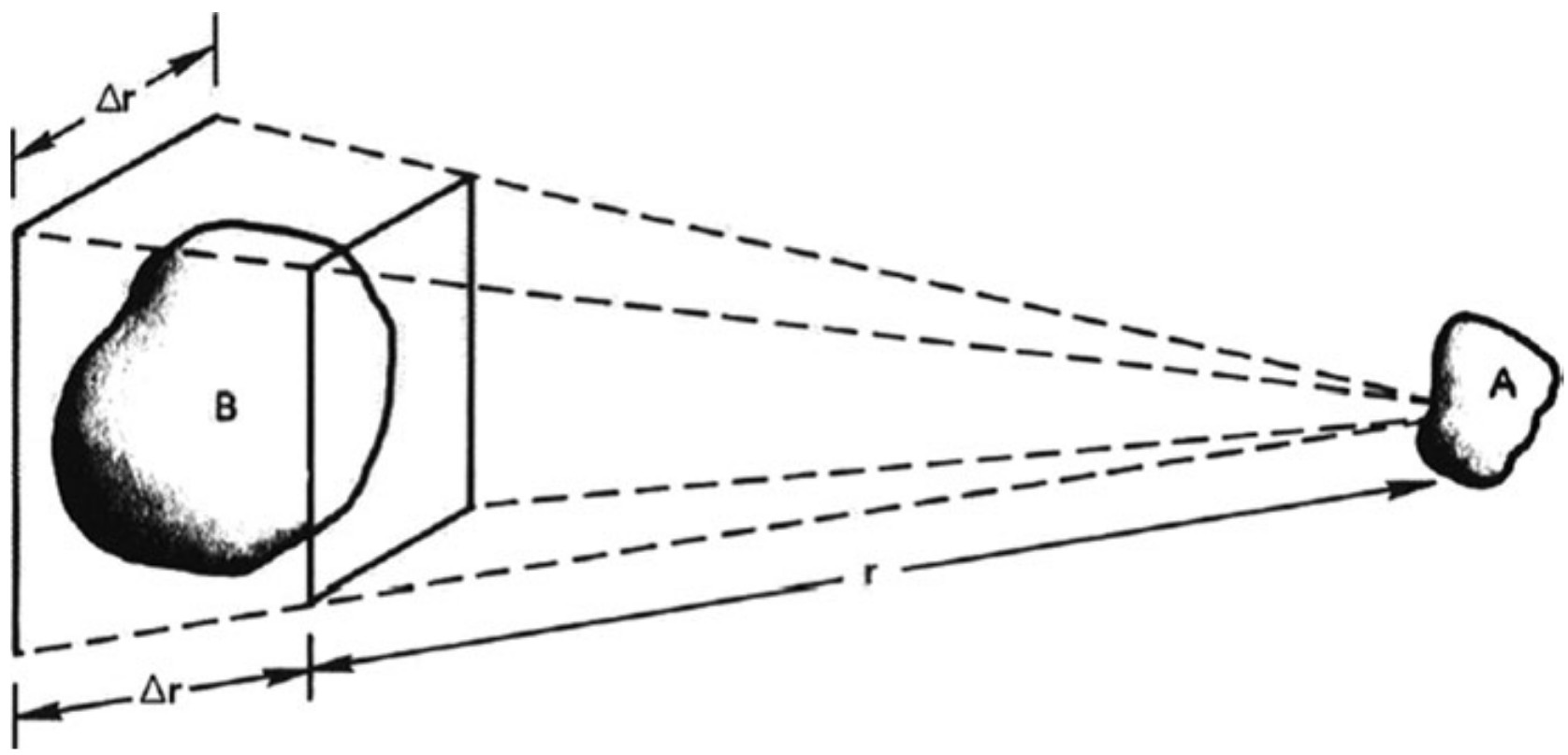
The long range of electrtostatic forces in a plasma

  • The Coulomb force between A and B diminishes as .
  • However, for a given solid angle($\Delta$r/r = constant), the volume of plasma in B that can affect A increases as .

The Saha Equation

Physical meaning
  • When temperature is raising, the whole value is increasing exponentially with .

  • The higher value of , the lower recombination rate of ionized atoms.

The Maxwellian Distribution

The one-dimensional Maxwellian distribution
Boltzmann’s constant K
The particles density n
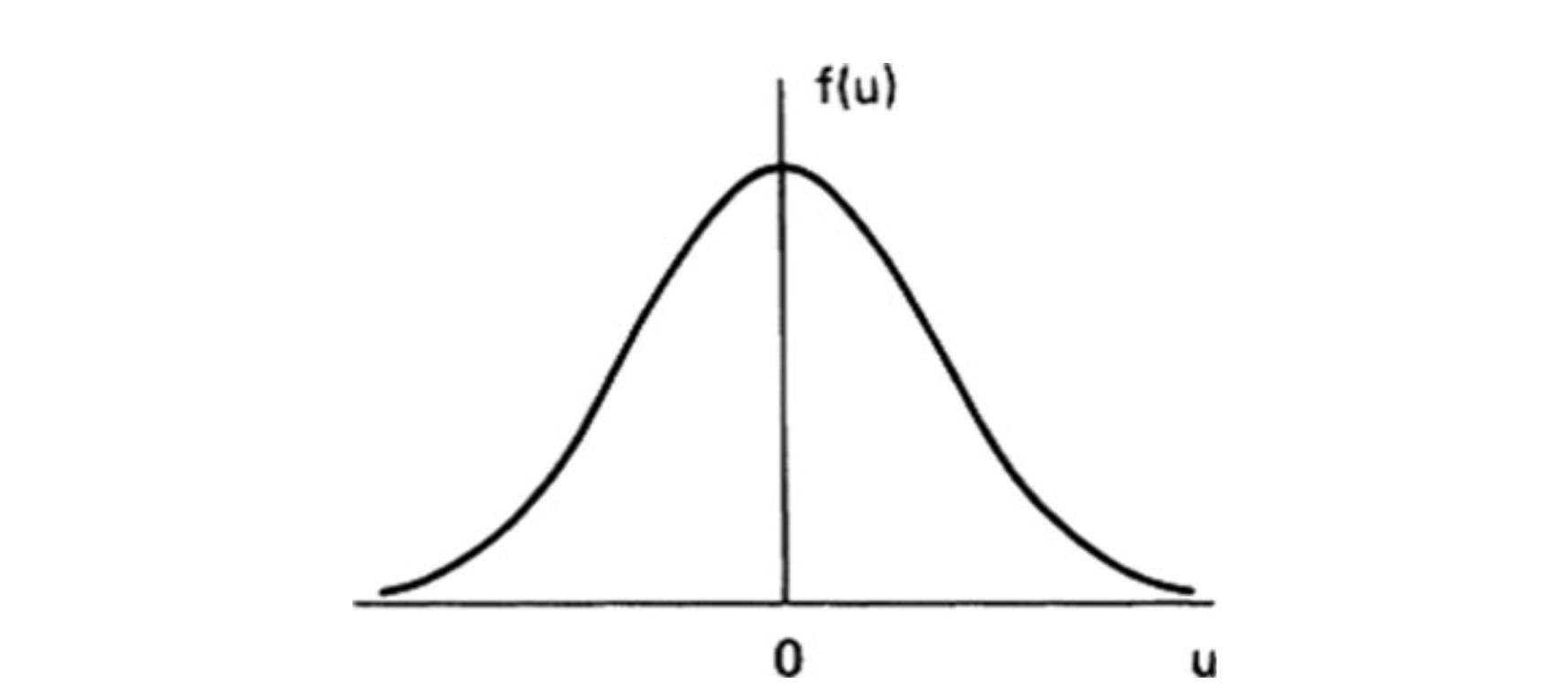
A Maxwellian velocity distribution

The average kinetic energy is $\frac{1}{2}KT$

The three-dimensional Maxwellian distribution

Reference Book
Introduction to Plasma Physics and Controlled Fusion by Francis F. Chen