Relation of Plasma Physics to Ordinary Electromagnetics

Maxwell’s Equations

In vacuum:

In a medium:

Classical Treatment of Magnetic Materials

Time Varying E and B Field

Time-Varying E Field

The electric field
The polarization drift

The polarization drift

Time Varying B Field

The magnetic field
The magnetic moment is invariant in slowly varying magnetic fields
The magnetic flux through a Larmor orbit is constant
  • is constant if is constant.

Two-stage adiabatic compression of a plasma

The First Adiabatic Invariant,
The Second Adiabatic Invariant, J
The Third Adiabatic Invariant,

Special Relativity

Coordinatizations of spacetime

Intuitively, an “event” is “something which happens at a definite place at a definite time”.

The set of all events is called spacetime.

coordinatization of

E onto the four-dimensional real vector space

Lorentz coordinatizations

Properties

(1)For any stationary standard clock with coordinates for all .

(2)Light always moves in straight lines with unit velocity.The function is of the form , where are constant vectors, and is a unit vector.

Minkowski space

Minkowski metric

Lorentz transformations

The Realm of Supervised Learning

Preprocessing data using different techniques

Getting ready
1
2
3
4
import numpy as np
from sklearn import preprocessing

data = np.array([[3, -1.5, 2, -5.4], [0, 4, -0.3, 2.1], [1, 3.3, -1.9, -4.3]]) ~~~~
How to do it…
1
2
3
4
# Mean removal
data_standardized = preprocessing.scale(data)
print "\nMean =", data_standardized.mean(axis=0)
print "Std deviation =", data_standardized.std(axis=0)
  • python preprocessor.py

Mean = [ 5.55111512e-17 -1.11022302e-16 -7.40148683e-17 -7.40148683e-17]

Std deviation = [ 1. 1. 1. 1.]

1
2
3
4
# Scaling 
data_scaler = preprocessing.MinMaxScaler(feature_range=(0.1))
data_scaled = data_scaler.fit_transform(data)
print "\nMin max scaled data =", data_scaled
1
2
3
# Normalization
data_normalized = preprocessing.normalize(data, norm='l1')
print "\nL1 normalized data =", data_normalized
1
2
3
# Binarization
data_binarized = preprocessing.Binarizer(threshold=1.4).transform(data)
print "\nBinarized data =", data_binarized

>

1
2
3
4
5
# One Hot Encoding
encoder = preprocessing.OneHotEncoder()
encoder.fit([[0, 2, 1, 12], [1, 3, 5, 3], [2, 3, 2, 12],[1, 2, 4, 3]])
encoded_vector = encoder.transform([[2, 3, 5, 3]]).toarray()
print "\nEncoded vector =", encoded_vector

Label encoding

How to do it…
1
2
3
4
5
6
from sklearn import preprocessing
label_encoder = preprocessing.LabelEncoder()
input_classes = ['audi', 'ford', 'audi', 'toyota', 'ford', 'bmw']
label_encoder.fit(input_classes)
print "\nClass mapping:"
for i, item in enumerate(label_encoder.classes_): print item, '-->', i

>

1
labels =

Nonuniform B and E Field

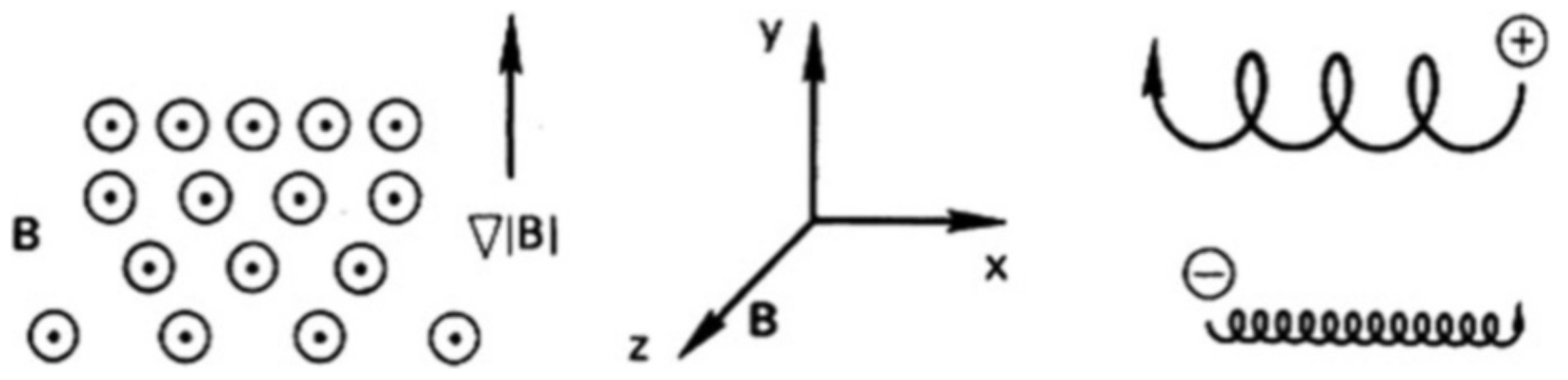
Nonuniform B Field

The guiding center drift velocity

The drift of a gyrating particle in a nonuniform magnetic field

Curved B: Curvature Drift

The centrifugal force
The curvature drift velocity
The total drift
: Magnetic Mirrors

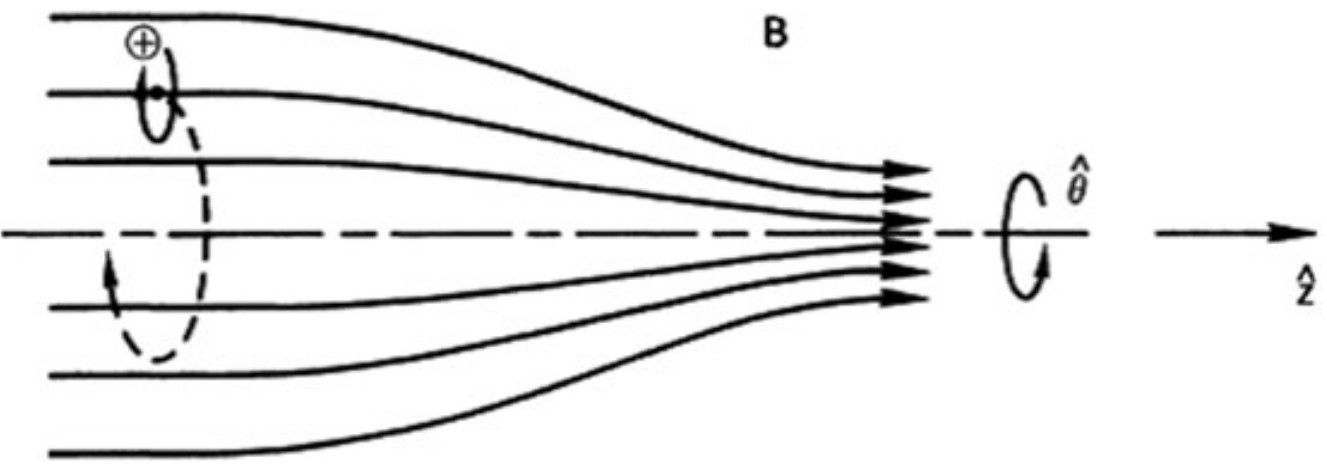
Drift of a particle in a magnetic mirror field

The magnetic moment of the gyrating particle
The average force

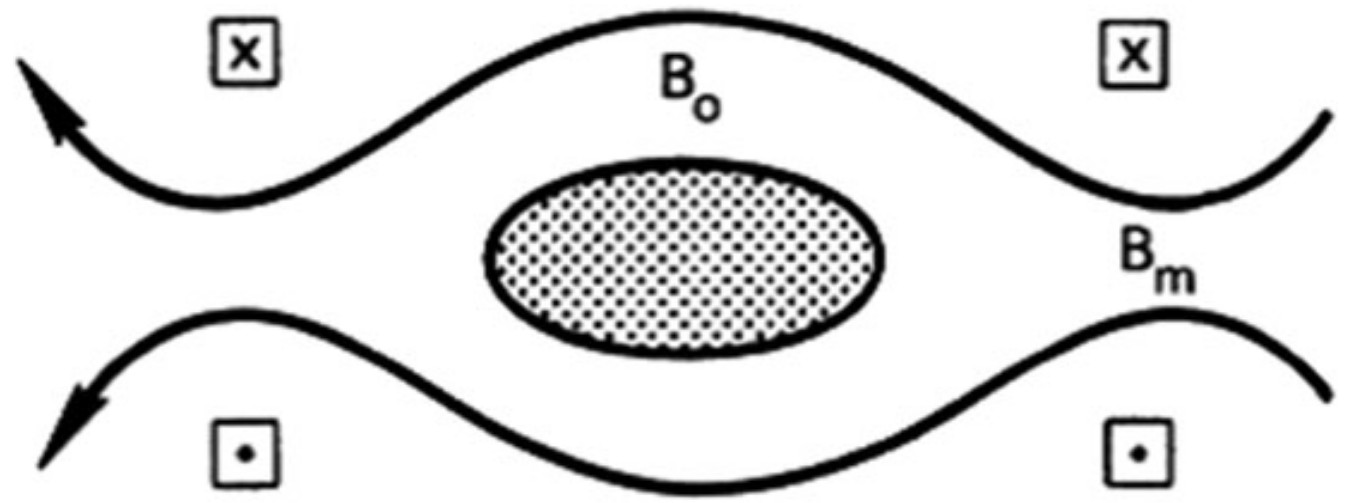
A plasma trapped between magnetic mirrors

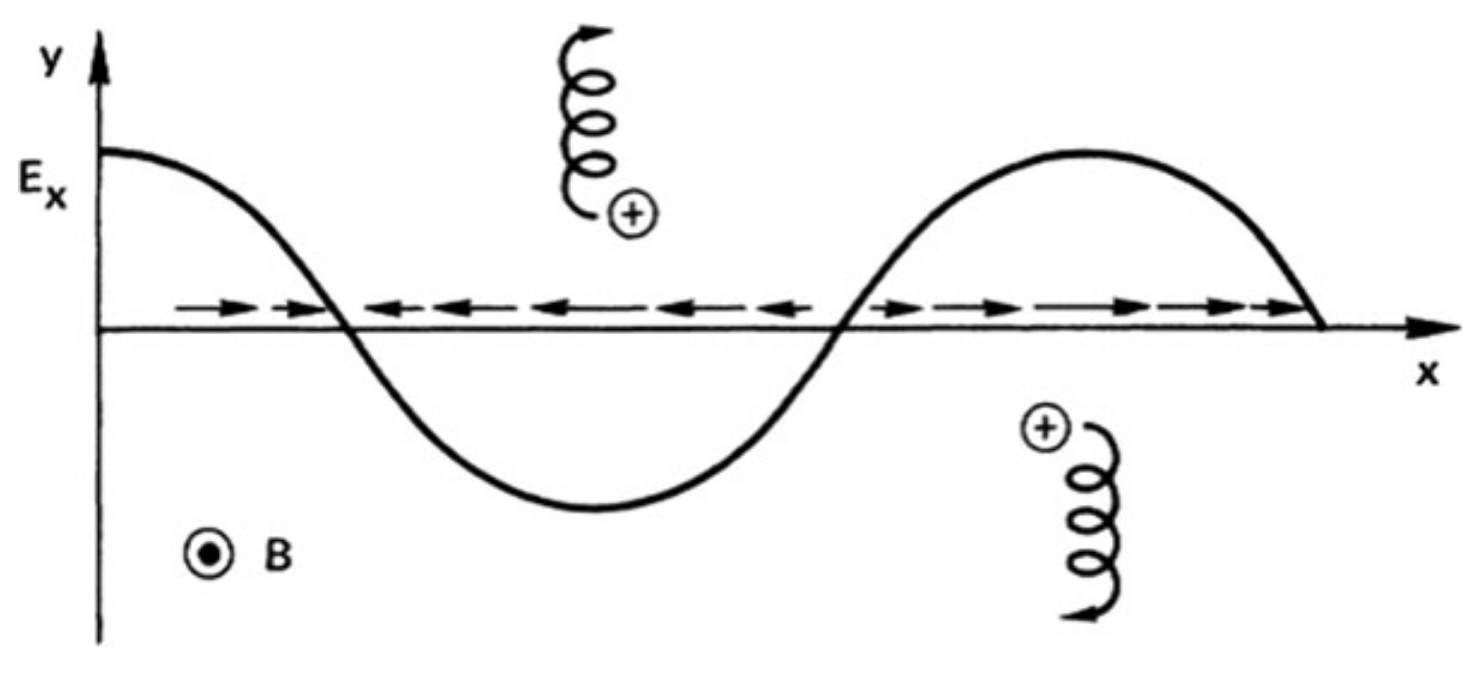
Nonuniform E Field

The electric field
The equation of motion

Drift of a gyrating particle in a nonuniform electric field

The finite-Larmor-radius effect

Introduction to Complex Analysis

holomorphicity

A function is holomorphic at the point if the limit

exists.

characteristic properties of holomorphic functions

  • Contour integration: If f is holomorphic in ,then for appropriate closed paths in

  • Regularity: If f is holomorphic, then f is indefinitely differentiable.

  • Analytic continuation: If f and g are holomorphic functions in which are equal in an arbitrarily small disc in ,then f=g everywhere in .

  • The zeta function

  • The theta function

  • Basic properties

The complex plane
Commutativity
Associativity
Distributivity
The absolute value
The triangle inequality
The complex conjugate
In polar form

Unique Factorization

The prime number theory

Lemma 1

Every nonzero integer can be written as a product of primes.

Theorem 1

For every nonzero integer n there is a prime factorization

with the exponents uniquely determined by n.

Lemma 2

If and b>0, there exist q,r\in\mathbb{Z}such that a=qb+r with

Definition

If , we define to be the set of all integers of the form with .

Lemma 3

If , then there is a such that (a,b)=(d).

Definition

Let . An integer d is called a greatest common divisor of a and b if d is a divisor of both a and b and if every other common divisor of a and b divides d.

Lemma 4

Let .If (a,b)=(d) then d is a greatest common divisor of a and b.

Definition

We say that two integers a and b are relatively prime if the only common divisors are , the units.

Proposition 1.1.1

Suppose that a|bc and that (a,b)=1.Then a|c.

Corollary 1

If p is a prime and p|bc, then either p|b or p|c.

Corollary 2

Suppose that p is a prime and that . Then .

Unique Factorization in k[x]

Reference book
A Classical Introduction to Modern Number Theory by Kenneth Ireland and Michael Rosen

Basics of Math and Graph

Linear Algebra

  • Scalar
  • Vector

  • The norm of a vector

  • The norm of a vector
  • The norm of a vector
  • The norm of a vector
  • The distance of two vectors
  • A set of vectors are linearly independent

not exist a set of scalars which are not all 0

  • Matrix

  • Matrix product

  • determinant

  • The inverse matrix

  • The transpose of matrix

  • The Hadamard product

  • Tensor: An array with arbitrary dimension

Probability theory

  • joint probability

  • conditional probability

  • The sum rule

  • The product rule

  • Bayes formula

  • The chain rule

  • The expectation of f(x)

  • The variance of f(x)

  • The standard deviation

  • Covariance

  • Gaussian distribution

  • Bernoulli distribution

  • Binomial distribution

  • Laplace distribution

Graph theory

  • Adjacency matrix

  • Degree matrix

  • Laplacian matrix

  • Symmetric normalized Laplacian

  • Random walk normalized Laplacian
  • Incidence matrix

For a directed graph

For a undirected graph

Creation and Annihilation Operators for Identical Particles

General formalism

The state space of a system of N distinguishable particles
  • The space of the completely symmetric states for bosons

The projectors

  • The space of the completely antisymmetric states for fermions

The projectors

  • The is the N! permutation operators for the N particles

  • The is the parity of

  • The subscript distinguishes the different permutations of the N particles, and therefore take N! different values

Fock states for identical bosons
  • The subscripts i, j, k, l, ..denote different basis vectors {} of the state space of a single particle